
Case studyBanking and payments engineering Name under NDA
Correct company claims in AI answers rose from 70% to 93%
- 93%
- 47
- 3x
Engagement period. The six-month engagement ran February 17-August 16, 2026; the report was dated August 17. The headline compares company-named AI-answer snapshots from February 17-19 and August 14-16.
Who the client is
Business and buyers. This company provides modernization, data integration and payment-platform engineering for UK and EU banks and payment institutions. Its English-language website supports evaluation by technology, security and procurement teams.
Company scale. The firm’s delivery capacity was roughly 100 billable employee/contractor equivalents. At kickoff, its website had about 250 pages.
What they came to us with
Buyer due diligence. The client wanted company-named AI answers to explain its experience, project responsibilities and delivery limits accurately. More qualified implementation inquiries were a secondary goal.
Company representation. AI answers sometimes described the firm as a banking software platform or overstated project ownership.
What they got
More accurate company claims. In 720 answers per snapshot, correct factual claims rose as the chart shows. Responses adequately addressing the buyer’s decision rose from 387 to 531.
February: 630 correct, 270 failed, of 900 claims checked
August: 1,116 correct, 84 failed, of 1,200 claims checked
- Correct
- Unsupported, contradicted or unverifiable
Bars are drawn to scale. Longer August answers made more claims, and fewer of them failed.
Better buyer coverage. In that same panel, adequately answered questions rose from 21 to 45 of the 60 asked. Each passing question needed at least nine of its twelve responses to address the buyer’s decision without unsupported material claims.
AI-assisted evaluation. In a cross-channel sample of 20 qualified prospects asked during qualification, 14 said they had used an AI assistant to research the company before their first meeting.
Qualified inquiries. Google-organic and identifiable AI referrals produced 29 more qualified project inquiries during February 17-August 16 than in the same period of 2025, an increase of approximately 161%. The qualified share of inquiries rose from about 30% to 53%.
2025 61 in-scope search inquiries
2026 89 in-scope search inquiries
- Qualified, Google organic
- Qualified, AI referrals
- Pending
- Rejected
Bars are drawn to scale.
The situation before the engagement
Business context
Supplier evaluation. Relationships and referrals drove acquisition. Banks needed to establish relevant implementation experience and who would maintain interfaces after handover.
Website and content
Scattered company facts. Project roles, locations, maintenance and security review were explained inconsistently. Pages confused implementation with product ownership, or a platform’s ecosystem reach with direct customer relationships.
Traffic sources
Acquisition mix. In the preceding year, direct visits and partner referrals brought more sessions than Google organic search, as the chart shows.
Search presence
Incomplete evaluation. AI answers left questions about capabilities and delivery boundaries unanswered. At kickoff, few monitored buyer queries showed the company on Google’s first page.
Previous approach
Disconnected publishing. Topic selection did not consistently reflect procurement and security questions. No shared fact register connected company pages, project histories and sales explanations.
The strategy we planned and why
Commercial and search priorities
Establish supplier fit. We distinguished systems the firm built from products it owned, explained project roles and identified what buyers could verify publicly or discuss during procurement.
Technical SEO priorities
Accessible evidence. We prioritized retrievable service and project text, accurate descriptions, consistent indexing signals and links connecting technical evidence to capabilities.
Content strategy and production order
Company facts first. We corrected company and commercial explanations, organized project evidence and due-diligence guidance, then expanded supporting engineering topics. Specialist review remained part of publishing.
Procurement questions. Guides explained maintenance and incident responsibilities, subcontractor involvement, handover and exit arrangements, and how buyers could request security evidence. Public pages described the process; project-specific commitments required an assessment during procurement.
Why the strategy fit
Concrete buying decisions. Integration experience, maintenance ownership and security-review arrangements helped banks assess suitability. General technology articles left those decisions unresolved.
What we did
Agency and client responsibilities
Agency delivery. Our services covered research, positioning, production and measurement:
- SEO & AI Search Strategy defined buyer priorities and positioning.
- Technical SEO improved access, metadata and linking.
- AI Search Optimization checked company representation in answers.
- Content Research & Strategy connected buyer questions to evidence.
- AI Content Production Systems supported drafting and approval.
Client involvement. Four technical reviewers each reserved two hours weekly for source interviews, content approval and sampled AI-answer review. Marketing published, engineers implemented fixes and sales qualified inquiries. Weekly strategy meetings taught fact maintenance and AI-answer interpretation. Six monthly payments of EUR9,000 totaled EUR54,000.
- 1Research, strategy and technical fixes
- Fact register
- Clearer commercial explanations
- Technical fixes and acceptance checks
- Delivery plan
- 2AI content production system
- Workflow from approved facts
- Specialist interviews
- Fact and link checks
- Human approval
- 3Ongoing production, measurement and improvements
- Articles and buyer guides
- Updated and consolidated pages
- Clearer capability pages
Client technical reviewers set aside time every week for interviews and content review
Phase 1: Research, strategy and technical fixes
Research and corrections. From February 17-March 16, we established the fact register, revised commercial explanations and agreed on a ninety-day plan. Public changes began February 20, after baseline collection. Engineers implemented fixes; we verified retrieval and page behavior:
- Made important service and project text retrievable.
- Corrected titles, descriptions, canonical tags and redirects.
- Aligned structured data with visible company and service facts.
- Checked crawler failures in server logs and links to capabilities and consultation pages.
Technical acceptance. Service and project descriptions became available in initial HTML. By March 16, we rechecked affected templates and commercial pages for accessible text, correct canonical targets and working redirects.
Phase 2: Building the AI content production system
Reviewed production. From March 17-April 16, we built and tested a workflow using approved facts, project histories and specialist interviews. It drafted explanations, checked facts and links, flagged unsupported claims and required human approval.
Validation checks facts and links and flags unsupported claims for the client reviewers.
Phase 3: Ongoing production, measurement and improvements
Publishing. From April 17-August 16, we published about 70 articles and buyer guides, reaching about 20 monthly after ramp-up.
Maintenance across the engagement. We updated existing pages, split equally between deeper revisions and targeted corrections, and consolidated others into retained pages with checked redirects. New articles and removed sources were separate from the updates.
- Kept as they were
- Deeper revisions
- Targeted corrections
- New articles and guides
One square per page. About 30 more pages were merged into updated ones.
Clearer fit. Capability pages linked project evidence and distinguished implementation from product ownership. Unsuitable inquiries prompted clearer service descriptions and inquiry questions.
Results
Search and AI results
February 2026August 2026
Correct company claimsChecked against approved facts
Favorable evaluationsAmong evaluative answers
Buyer questions answeredQuestions passing the coverage check
Responses meeting the buyer criterionSame coverage rubric, per response
Of 720 answers in each snapshot
February
August
Same answers
February
August
The client and four fixed competitors
February
August
Supplier evaluation in ChatGPT
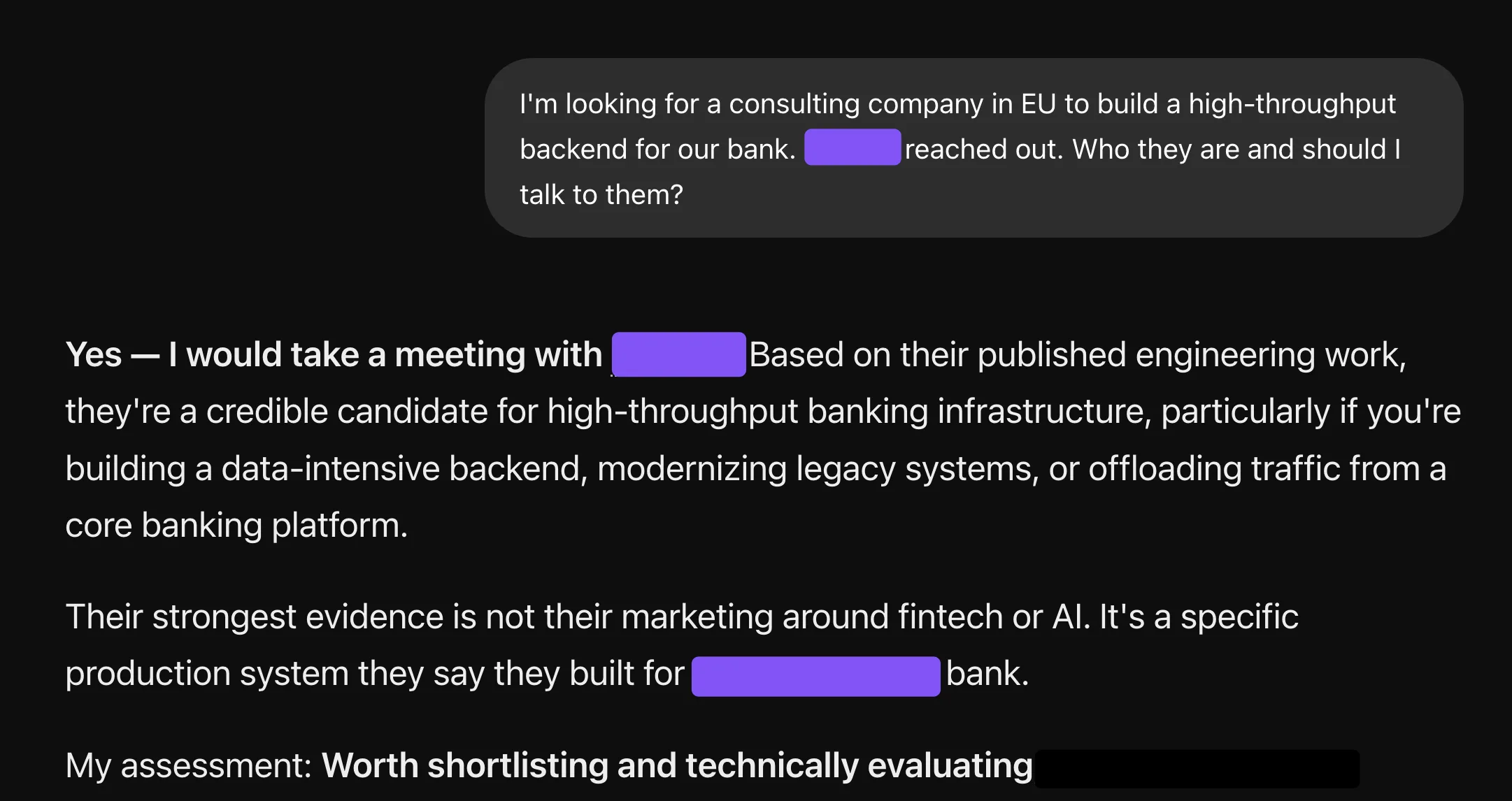
ChatGPT assesses a supplier for a high-throughput banking backend; company and customer names are redacted.
Assessing project fit. Asked whether the supplier was worth meeting, ChatGPT recommended a technical evaluation and connected its published engineering work to the buyer’s backend requirements.
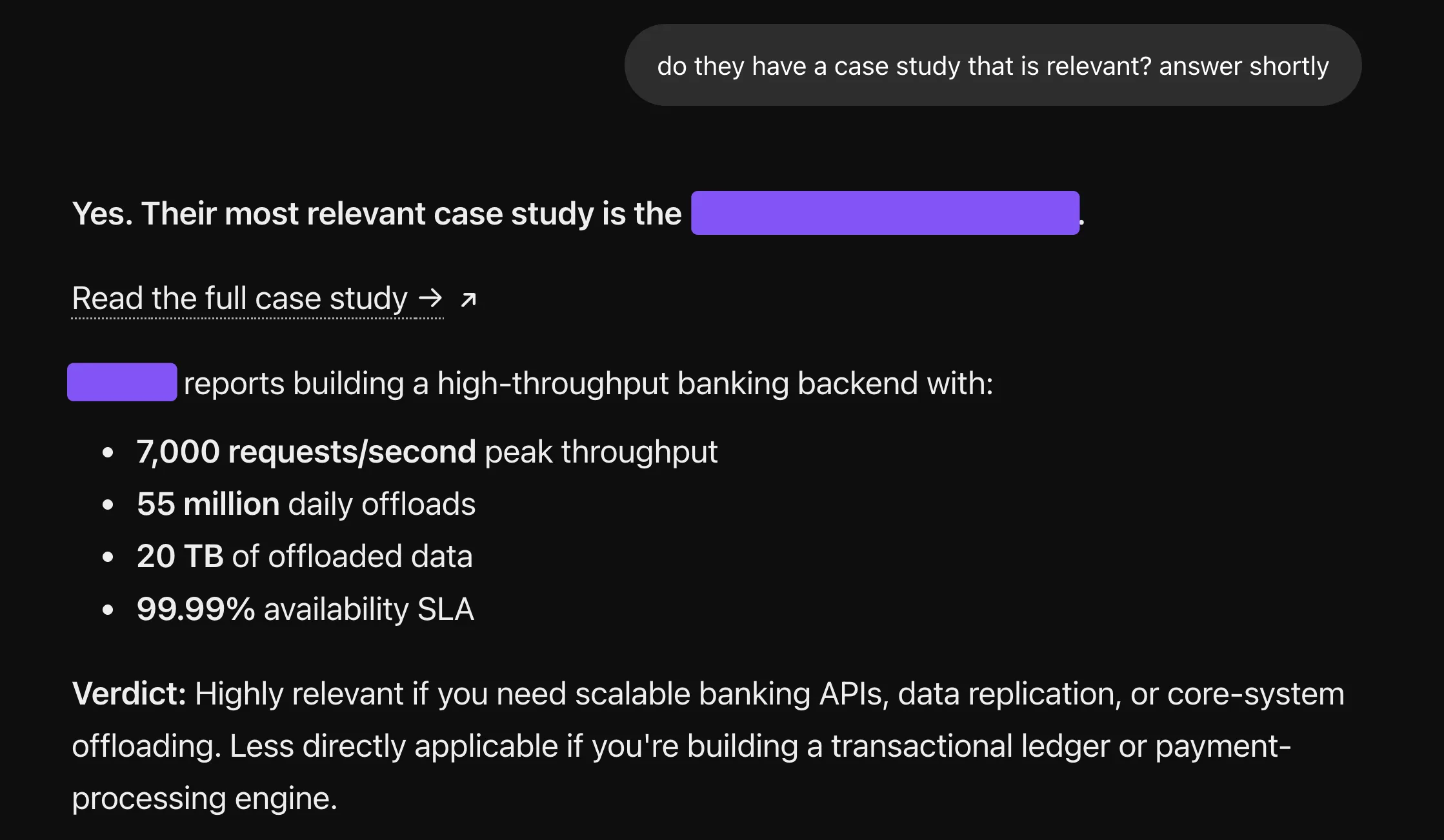
ChatGPT retrieves a relevant banking case study, summarizes its reported performance and explains which projects it fits.
Finding relevant experience. The follow-up answer linked to a published case, summarized the supplier’s reported performance and distinguished core-system offloading from building a transactional ledger or payment-processing engine.
Unbranded discovery
Organic search
18 in the top ten at kickoff
34 at the end
- Google top three
- Positions four to ten
- Below the first page
One square per query in the same fixed panel of 120 UK-English buyer queries, checked at kickoff and at the end.
February 17-August 16, analytics
2025
2026
Business results
How prospects evaluated the supplier
Qualification conversations. During the engagement, sales asked qualified prospects from different acquisition channels: “Before we spoke, did you use an AI assistant to look into our company? What did you want to find out?” Each response represented a separate project.
Reported AI use. Fourteen of those 20 prospects reported researching the company with AI before their first meeting. The sample included referral-led prospects alongside search-origin prospects. Sales recorded AI use separately from how each prospect first discovered the supplier.
What buyers checked. Follow-up questions covered relevant experience, technical capabilities and the company’s role in previous projects. These conversations connected our company-named answer checks to the questions prospects brought into supplier evaluation.
Qualified search inquiries
Qualification. Both years required a verified business contact, relevant need, defined scope, credible planning window and identified prospective budget owner. Forms and emails established initial fit; funding approval belonged to a later stage. Missing information stayed pending; explicit unsuitable work or confirmed absence of project scope led to rejection.
Better-qualified inquiries. Qualified share rose from about 30% to 53%, an increase of about 23 percentage points. Total inquiries grew by approximately 46%, while rejected inquiries fell from 41 to 39.
Business interpretation. Company representation improved in the monitored panels, alongside more qualified search inquiries. The year-over-year comparison also reflects audience mix, sales activity and market conditions.
Conclusion
Clearer supplier evaluation. The monitored answers contained more accurate company claims and addressed more buyer questions adequately, alongside increased qualified search inquiries. The client retained the approved fact register, specialist review process and publishing workflow to maintain explanations of its experience and responsibilities.
How we measured
AI answer measurement
Question selection. Before February 17, we fixed questions from sales and procurement topics and editorial gaps. They covered implemented systems, product ownership and maintenance responsibilities.
Separate panels. Profound captured answers to 60 company-named and 60 unbranded questions using UK-English settings on ChatGPT, Perplexity, Gemini and Claude. Daily runs over February 17-19 and August 14-16 yielded 720 answers per panel in each snapshot.
Evaluation rules. Our scoring assessed every checkable company-specific claim, excluding generic advice and opinions. Repetition counted once within an answer and again across answers. Unsupported, contradicted or unverifiable claims failed. Project leads verified implementation roles; accountable company owners verified ownership, relationships and obligations against relevant records.
Comparable scoring. Both snapshots were scored together with the same evaluator configuration and reference register, covering facts effective at both dates. More detailed final answers increased assessed claims from 900 to 1,200; failures fell from 270 to 84. Coverage additionally required a useful answer to the buyer's decision without material errors.
Review. Technical reviewers checked exceptions and a sample spanning every engine and day, with dates hidden. Disagreements returned to source evidence; systematic scoring errors triggered rescoring. Results describe these endpoint snapshots.
Evaluative language. Thirty assessment questions yielded 360 scorable responses per snapshot. Correct limitations could receive neutral or negative sentiment while passing accuracy and coverage. Favorability describes tone; supplier fit governed the work.
Discovery rules. Citations indicate source use. Selected-brand share counted each brand once per answer across the client, Ailleron, FINANTEQ, FINGO and ScienceSoft. Company-named questions received no discovery credit. Engine changes and sampling variation could affect both panels.
Search measurement
Search scope. Organic visits increased approximately 46%; identifiable AI referrals were separate. Rankings counted the highest client organic result per query, excluding ads and AI answers. Top-three positions were included in the top-ten count.
Inquiry counting
Inquiry cohort. Every row covers distinct projects received during February 17-August 16 in the respective year, with an in-period search origin under the ninety-day attribution rule below. Records required consented linkage. We recorded each project's status at cutoff; only projects qualified by that date counted as qualified.
Counting. Repeat contacts and submissions merged into one project. Separate projects at one institution required distinct scopes and procurement decisions. Arrival cohorts received their final status at cutoff; unresolved inquiries remained pending.
Observed origin. A form identifier linked consented analytics to the deduplicated project. The earliest identifiable non-direct visit in the ninety days before each inquiry set its provisional channel. Earlier sales-recorded origin and known pre-existing opportunities were checked; referral, partner or outbound origin overrode search attribution.
Cohort boundary. A January search visitor submitting in March was excluded as prior-period acquisition. Existing-client expansion and unresolved sources were also excluded. The rule identifies earliest observed origin from available visit and sales history.
Comparable records. Source linkage and the required qualification fields were collected before the 2025 baseline, using the same rules in both years. Seven identifiable AI inquiries in 2026 produced four qualified projects, two rejections and one pending decision.
Become the brand
AI recommends
Book a free 30-minute call with Eugene. Before the call, we check what Google and AI say about you. On the call, you get the first steps to make AI recommend you.